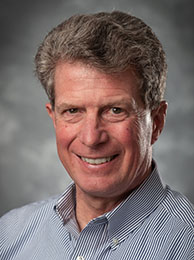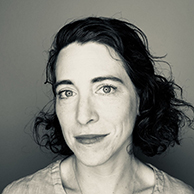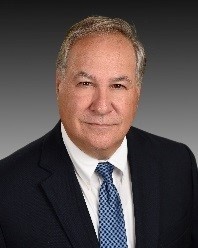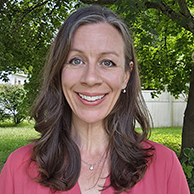



Written by Lillian Chase
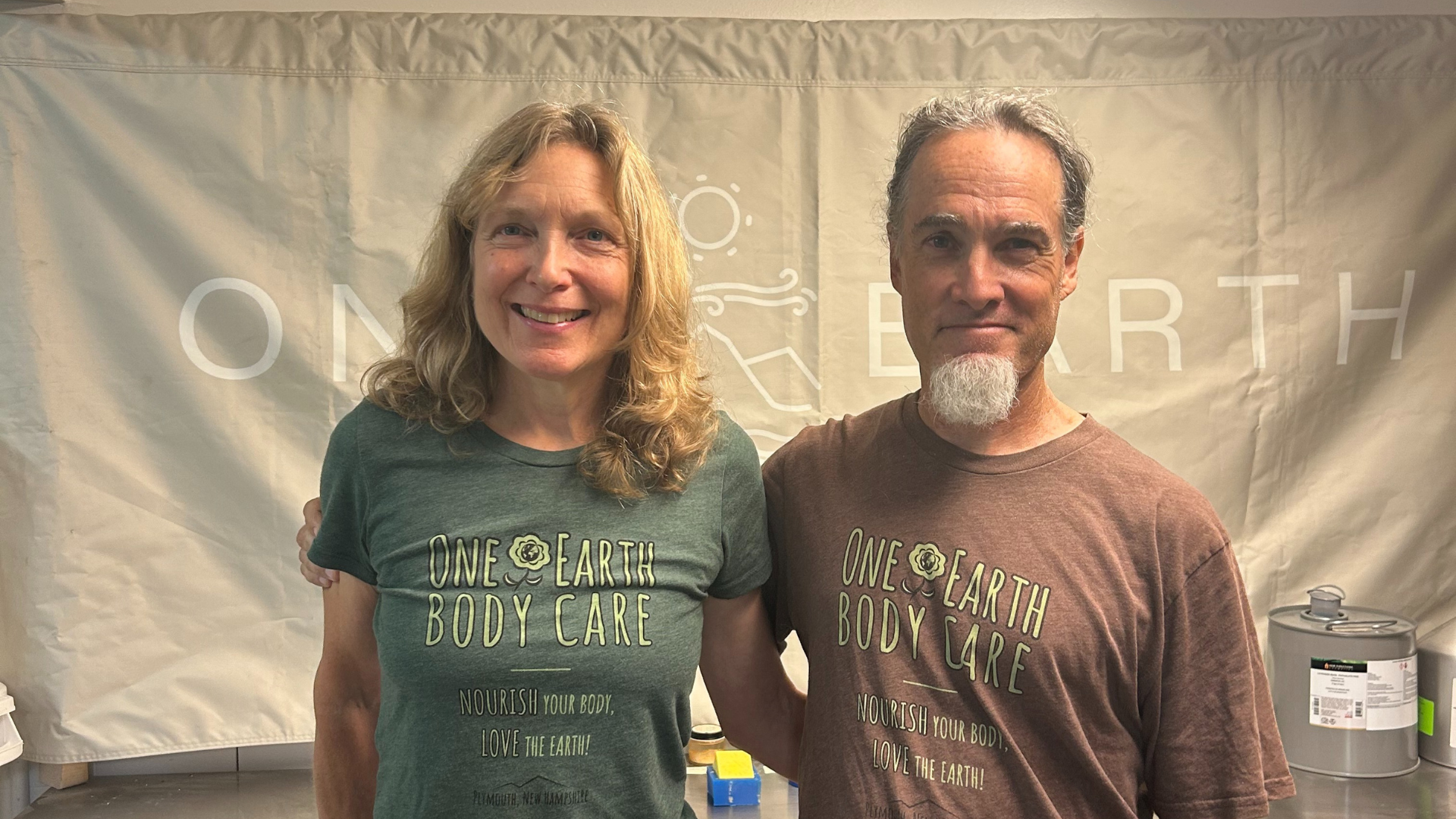
In August, Sara and I had the opportunity to visit Ed and Anne at their workspace in Plymouth, NH where they’re creating and shipping One Earth Body Care products. In their PitchFork Challenge pitch, they shared that they were planning to use some of their winnings to create new branded molds for their shampoo and conditioner bars. After working with Hannah Grimes coaches and local students, we got to see the first sample of new bars.

We toured their space, did a blind smell test of their deodorant products, and talked about packaging before sitting down to interview them about their experience with Hannah Grimes, their business values, and how they came to be One Earth Body Care.
Q&A with Anne Altor and Ed LaPlante
Lillian: First, let’s talk about PitchFork Challenge. How did you hear about PitchFork?
Anne: We heard about PitchFork from Janie Wang, our Small Business Development Center (SBDC) advisor. She put it on our radar.
Lillian: Why did you choose to participate in PitchFork?
Ed: We knew it was going to be a reasonably significant, big investment, but we figured win or lose the experience of going through it—meeting the coaches, meeting the team and the network—would be worth it. We were absolutely right. We really benefitted from all the folks that we met, conversations we had, and feedback we got.
Lillian: What kind of feedback from the program did you feel was instrumental to what you’re doing now with the business?
Anne: One of the things that jumps to my mind is just the iterative feedback each week from the coaches and working on the pitch and having the six minute time-frame. Our inclination, or at least mine, is to want to talk all about sustainability and that’s important and it’s key to what we do, but we realized we’re not talking about the products enough. We’re talking a lot about the vision and what’s behind the company, but we also need to really promote the products and talk about why they’re great and that was so helpful. Just coming to that through the feedback over the weeks, realizing that we can do a better job with that.
Lillian: Do you feel more confident in your business now, after competing in and winning PitchFork.
Ed: It was a really nice experience and going through it definitely made us feel a little more confident in that we were able to communicate our vision. Not just our vision, what we were trying to do, but also the reality of the business performance—what we’ve done, our past successes and failures, and the momentum that we’re following. That felt really good. It’s fun to leverage that when we’re having conversations with potential customers or wholesale clients.
Lillian: At Hannah Grimes right now, we’re talking a lot about the economy and what endless growth really means. You talked a little bit about that in your pitch, I’d love to hear more about your values behind not striving for endless growth.
Anne: That’s huge, I think. It’s part of the economic paradigm that’s driving us off the cliff—that we can just keep growing, use the resources, they’re limitless and they’re not. We all know that and we all can see where it’s taking us. This mindset that we can grow forever just doesn’t serve on any level. We believe in being as local as possible. We’re happy to be a regional company, that’s sort of necessary just to be sustainable economically. A certain amount of scale is important, but we also feel it’s really doable to say okay we can be this big, we’d like to be this big and we don’t need to be any bigger. Yes, we need a certain amount of income, we’d like our employees to have a certain amount of income. We’d like to reach enough people to have an impact with the plastic-free vision and the other things behind that, but we don’t want to be a big corporation. We want it to be relatively mom and pop and we want to know who our customers are, who our employees and contractors are and have a sense for what we are taking from the earth to produce these products, to ship these products, to distribute them and what are we able to give back too. That’s all more manageable at a local to regional scale.
Lillian: I’d love to hear a little more about your business values in terms of what you’re giving back.
Anne: We give 2% of our sales back and the way we see it is that everything is connected. We feel we’ve been privileged in our lives to have the opportunity to have a business and to do the things that we’re doing, to have the time and creative energy to develop the products that we do, and we feel it’s just critical—even if it’s not a huge amount of money—to give back in a way that supports others who either aren’t as fortunate or who are doing work that we believe in to conserve the planet, to promote food justice, or social justice, so we’ve contributed to a variety of organizations over the years from Soul Fire Farm to Monadnock Conservancy to the Northeast Wilderness Trust and a couple of other regional organizations that aren’t as well known that promote educational opportunities for people that haven’t have the privilege of access to education.
Ed: I think there are 21 different organizations listed on our website right now that have received donations from us over the years.
Lillian: That is the impact like you were talking about. You don’t have to be a big corporation to see that impact.
Anne: And we can also share. That’s another way to have the impact is to share with our customers and blog readers, this is why we support these organizations, this is what they’re doing and other people can maybe support them too.
Sara: I’m always curious to know what drives folks towards business ownership. We’ve heard a little bit about your business values and I’d love to hear more about your personal story, your backgrounds and how you came to start One Earth.
Ed: I worked in big companies and corporations, consulting primarily, doing software, project management, and data science, for about 20 years and just felt like I really needed a change. I wanted to work with people more and work with solving smaller projects and problems that weren’t going to take multiple years to come to fruition. I’ve been running small businesses since 2000. I guess it was probably 2015 or so when Anne and I were each running our own different businesses and I realized Anne was coming back from a stressful day at work and she would go in the kitchen and she would start making soap and she’d make deodorants and candles and natural things. It was a salve to her stressed out day and it took a little while, but we just decided to try to leverage this energy and Anne’s creative talent and this deep knowledge that she had in formulations to bring a product and create something different. Those are the origins from my perspective. She’s got a different one.
 Anne: Yeah, all of that and there’s so many factors and it’s chance. It’s the path life takes you on. I’m an environmental scientist and that’s my passion and making has always been something I’ve loved and I’ve always done for a creative outlet, stress release, for fun, and for gifts, but I never envisioned this being a business and there are a lot of things that led to working in other jobs and being disenchanted. Where we were living at the time was Indiania, but we were planning to move and we decided that we were going to try to make this happen and make this something that would move with us and also in the process of making products, I came to realize that there’s so much environmental science involved. It’s the formulation, but it’s also the ingredients—where are they coming from? Where are they produced? What are they? So, it started with soap and realizing that palm oil was a major ingredient in a lot of soap, but also body care in general and food too. Palm oil is a major cause of deforestation, so we don’t even make soap anymore but that started me off on the path of really looking at the environmental implications of body care and then the packaging of body care and wanting to—myself—not wanting to go to the store and buy something in a plastic bottle and wanting to have options so all of that cascaded into deciding that this was an opportunity. There was a niche that wasn’t necessarily filled, there was room for more innovation in the plastic-free body care area with conscious ingredients. It started as a side hustle and then it grew from there and we let our other businesses go. We moved out to New Hampshire and there were a lot of opportunities here. There’s amazing support for small businesses. There are fairs, there are opportunities, so it’s been a good location to make it happen.
Sara: Interesting, I didn’t realize that you weren’t native New Hampshireites. That you hadn’t been here for a long time.
Anne: I’m a Pennsylvaniaite. Ed’s an Illinoisite.
Sara: How’d you pick New Hampshire?
Anne: I spent a lot of time living in upstate New York. I spent a lot of time up this way as a young person and just had it in my vision to be here. It’s where I’ve always felt like I belonged. The whole region, not just New Hampshire, but we just had it in our sights for years. We came up here, got married out here, and Ed loved it too. We weren’t sure we’d land in New Hampshire, but it worked out that way.
Ed: We both knew we wanted to move to the mountains. I didn’t have very much experience in the mountains, but Anne has already lived out west and she knew how dry it is. She knew how much she really wanted to be in a temperate region that was going to have plenty of rain and four seasons. So, we wound up out here.
Sara: Do you have stories from the early days of your friends and family either encouraging you or trying to steer you away from business ownership?
Ed: Yeah, I remember my daughter, Chloe, when we were getting started with One Earth saying, You know, dad, this doesn’t make sense to me. You hate shopping. Why are you going down this path that’s going to require you to think like a shopper and sell your products in a retail store? It just made a lot of sense to get beyond that aspect. That’s true. I don’t like shopping, but I enjoy helping people find what they’re looking for and helping people understand that there are great options out there that don’t include plastic packaging and rainforest destruction. If we can move those things out of our daily routines or start new things that are for a more sustainable lifestyle.
Sara: What would you say to somebody wanting to start a business that really holds and shares some of these values? We’re in a big exploration at Hannah Grimes about how we can explore regenerative economics and alternative ways to build economies and have business ownership. Having walked this path and found success, what would you say to someone who wanted to reshape their existing business or start a new business that has some of these same triple bottom line values?
Anne: One thing right off the bat would be to take advantage of the support that’s available. Work with the Hannah Grimes Center, work with the SBDC and get involved in learning about the triple bottom line. What does it really mean? What does it mean on a personal level? Take a good look at the numbers. It’s great to have values, but you also have to have a certain amount of profit to make it work and that’s tricky. My inclination has been okay, well how do we be the most sustainable we can be with our ingredients with our packaging, etc. and that’s important but if it’s not profitable… I’m not saying one should compromise their values, but it’s important to learn to look at the numbers to understand what it would take. What are your costs? It’s one thing to have an idea, but what does it cost you to make that body bar or whatever it is you’re making? What are your true costs? What are the equipment needs that you have? What are the regulatory requirements? All businesses have regulations. Different ones for different types of businesses, so that’s important too. Get involved with organizations. For us, the Handcrafted Soap and Cosmetics Guild has been a helpful organization. We get our insurance through them and because they have a lot of members, they can get better rates on insurance. Using the support, thinking about costs, thinking about how to live true to the values and also make it profitable.
Sara: Did you have any early mentors that helped you? How did you learn the craft? Was it totally self taught? Did you have people you looked up to or connected with in the natural body care space?
Anne: I’ve definitely been a tinkerer. I’ve taken advantage of a lot of reading about hair science. There are people who have done some of the animation and written about it, so as a starting point for example, we started with soap. We don’t make soap anymore. Hair products are completely different. They have a low pH. It’s a completely different process, so I did a lot of reading and looking at formulation information and then I started experimenting. I didn’t know other people making shampoo. We did a lot of testing on friends and family and refining and the initial recipes took about nine months and we’re in a revision stage now, which is really exciting. Mentors? Not so much for the body care—for the actual formulation. Although, like I said, there are resources online that I’ve taken advantage of. We’ve had business mentors all along the way. Initially, way back in 2017, we had an amazing business mentor named George Talbot and he was a business professor and he helped us learn about marketing. We were able to work with some of his classes to have market research. He was a huge mentor for us in the business sense. He really helped us to get started. He helped us to see that it could be possible. He was really important to us.
Sara: One thing I really appreciate about you guys is your willingness to find support. I think that speaks really highly of your skillset as business owners. One more question from me: What’s one thing about running this business that you wouldn’t have thought you’d have to do on a day-to-day basis?
 Anne: There’s so many things you don’t think about. One thing that comes to my mind is inventory management. How do we do that? How do we manage our packaging, our raw materials, our finished products? I’m not saying we’re experts. Having a great system is an area we definitely need some improvement on, but I never thought about that. How I’d be managing inventory of all these things and keeping track of it and knowing where to order it from. How to source. Some of our packaging and raw materials come from China. I never thought I’d be learning how to use Alibaba.
Ed: I think about just the general problem solving. We had a need to streamline our display in our booths and last year we got some input for some different ways to think about displaying. We wound up taking that input and tweaking it, modifying it, and making them ourselves. We had some quotes to have them made and they were really crazy expensive, so we were able to figure out how to put those together ourselves
Sara: Is there anything else that you want to share?
Anne: There are conventional ways to do things. There’s conventional wisdom and there’s some wisdom in that, I’m sure. But, one of the things that we do with our website is that we have a blog and it’s got a lot of content that’s not really in the body care space. We have recipes in there, we’ve got environmental posts about environmental issues, butterflies, how do they overwinter, how to feed hummingbirds, how to mow your lawn without killing everything in your lawn. It sounds random, but my feeling about it is that everything is connected and I would encourage anyone that’s interested in what we do to look at our blog and I also encourage people setting out on the business path to not completely follow the recommended protocols. Some would say that well that’s not going to help your search engine optimization, you should just write about body care, but the way we see it is that everything is connected. The products we use are connected to the whole globe, how we dispose of them. Our everyday choices are all interconnected, so we like to explore a variety of topics on our blog and I would encourage people to check that out.
Ed: We’re so used to hearing about major attributes of a business, whether it’s the processes, the outputs, the inputs, as being considered externalities that shouldn’t figure into the calculation of our costs because it’s not something we pay for directly, like air pollution. Maybe we’re buying raw materials from an organization that has some irresponsible business practices and I feel like it’s important for business owners to really consider how we can be responsible for removing those negative consequences from our processes, our products, our output, our packaging. Even though those things might be considered externalities today, so many of them are drifting towards bigger problems that lead to social and environmental problems. We’re cutting off our nose to spite our face if we’re not considering those things. Sure, we might be more profitable in the short term if we don’t, but in the end we’re not doing ourselves and our communities any good by failing to address those.
Anne: Internal consistency is I think what you’re talking about and I totally second that. For example, we just learned about a vegan company that is creating a healthy bar with great ingredients, but they’re packaging it in plastic packaging and that’s an example. They have a great idea. It could be an important product, but we’d like to encourage other companies to look at as many of the aspects as possible and try to seek out responsible packaging. The more of us that demand it, the more of a market there will be for it. It can be hard sometimes because it is more expensive to put a product in cardboard or glass or metal, but it’s possible.
Ed: That doesn’t mean that it can’t be profitable. Maybe not as profitable or as scalable, but in my opinion, it’s much more likely that you’re going to be able to have a sustainable system if you keep it relatively small. If you try to scale to very large scales, it’s incredibly difficult to avoid those external downsides. The cost of scaling up is incredible.